
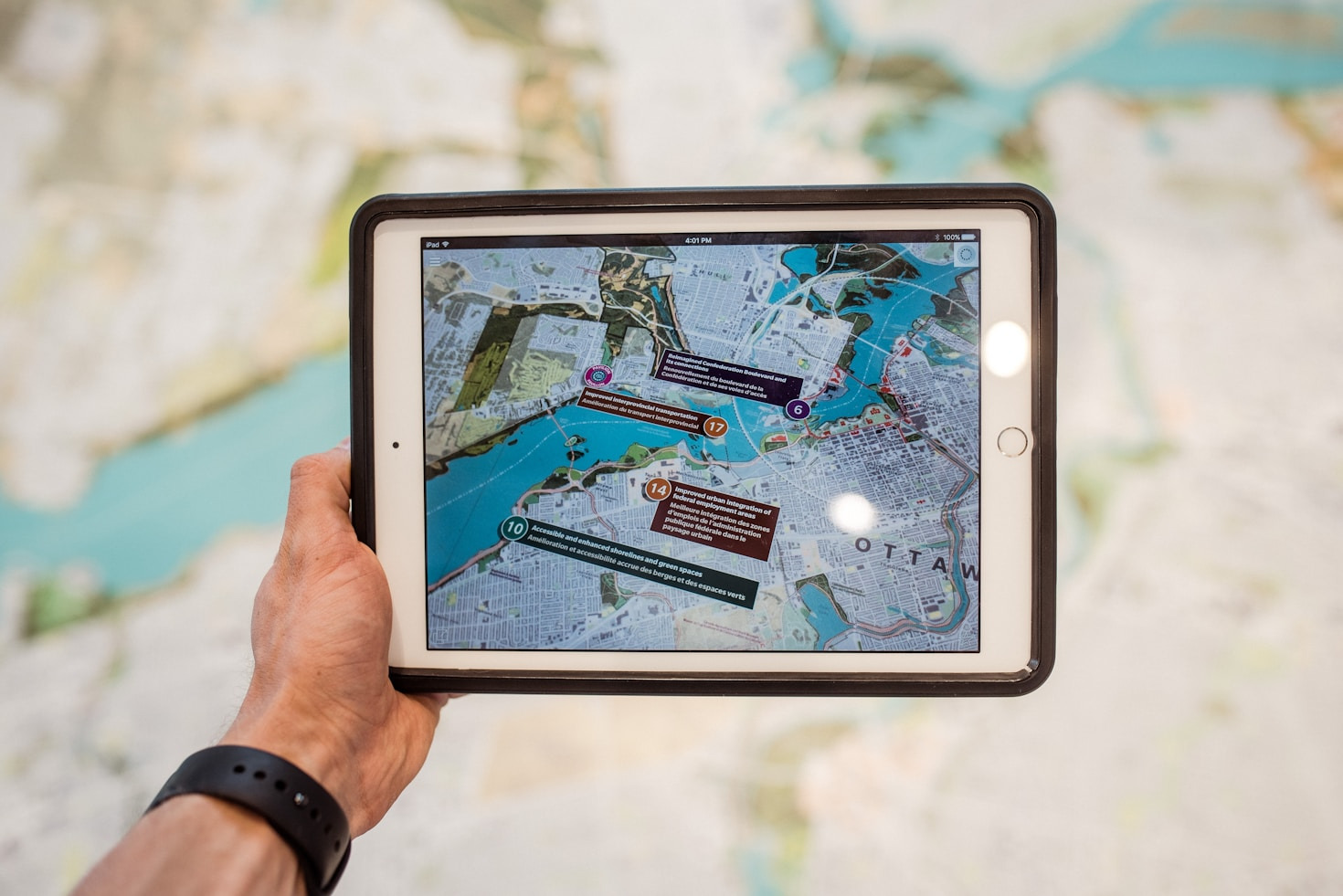
Our living environment is at a tipping point. Challenges are piling up: housing, accessibility, energy transition, climate adaptation, health, liveability and affordability have to be realised simultaneously, often in the same square kilometre. At the same time, the amount of data and digital capacity is growing explosively. Where planning traditionally revolved around maps, reports and periodic decision-making, a new working model is now emerging: continuous insight, scenario-driven steering, and cooperation based on one shared reality. Digital technology makes this possible - provided we deploy it with discipline, governance and human-centred design.
Technology primarily enhances what you're already doing; with clear values and shared rules, it helps you move forward faster.
The essence of the digital future in transition planning is not “more data”, but better decision-making under uncertainty. Digital technology - such as sensor networks, advanced GIS platforms, AI-assisted analytics and especially Local Digital Twins - shifts the focus from static plans to dynamic scenarios. Instead of one preferred variant on paper, communities can test policies and investments against multiple futures: what happens to traffic flows and air quality if you make a neighbourhood car-free? What grid congestion results from large-scale residential sustainability? Where do heat stress and flooding increase with more extreme weather, and which measures demonstrably reduce risk? In a Local Digital Twin, data (assets, networks, indicators), models (e.g. mobility, energy, water) and visualisations (dashboards, 2D/3D) come together in one interoperable whole. This makes choices more transparent: assumptions become explicit, effects become measurable, and trade-offs become discussable with residents, businesses and administrators.


Crucially, this only works if governance is as mature as the technology: who manages definitions, who is responsible for quality, which data may be shared under what conditions, how do you prevent bias, and how do you ensure privacy by design? The digital city is therefore not primarily an IT project, but an organizational model for collaboration – with digital tools that enable trust, speed, and scale.
Important insights
The future of transtie planning lies in hybrid craftsmanship: human judgement enhanced by digital precision. Those who deploy digital technology as an “extra layer” on top of old processes mainly get prettier pictures. Those who use it as an engine for a new way of working - with shared data, scenarios, clear governance and real participation - can deliver faster, account for better and distribute more fairly. The smart living environment is not the one with the most sensors, but the one that learns best, makes decisions transparently and executes them reliably.
Leave a Reply